
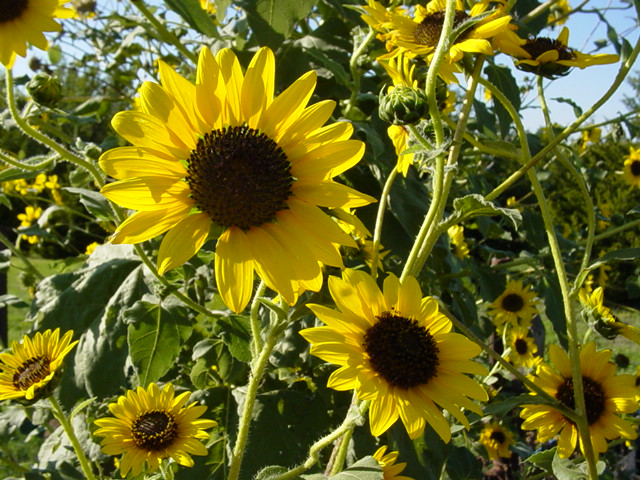
State Flower: Native Sunflower
Updates in 2026:
- HB2434/SB315 [LS/LS] Making and concerning supplemental appropriations for fiscal year 2026 and appropriations for fiscal years 2027 and 2028 for various state agencies, authorizing certain capital improvement projects and fees, authorizing certain transfers; The bill provides the fiscal authority for the Kansas Department of Agriculture to utilize specific funds, including the “Soil amendment fee fund,” for its operations and programs; includes $400,000 for soil health initiative
Updates in 2025:
- HB2063 [LS] Establishing various conservation funds, allocating state moneys for conservation, requiring reports to the governor and legislature, and authorizing fund transfers and providing for the use of such funds by the Kansas department of agriculture and the Kansas department of wildlife and parks; Creates state, working lands, wildlife and outdoors conservation funds; eligible grants must benefit the natural resources of the state, and includes irrigation efficiency, grazing, and “soil health practices; practices that promote or regenerate soil ecosystems, biodiversity and native grasslands” – committee recommended bill be passed, stalled in House
- SB125 [LS] Making and concerning supplemental appropriations for fiscal year 2025 and appropriations for fiscal years 2026 and 2027 for various state agencies, authorizing certain capital improvement projects and fees, authorizing certain transfers authorizing the payment of certain claims against the state; General appropriations act; provides $400,000 for soil health initiatives for FY2026 – signed 4/10/2025
Updates in 2024:
- HB2273 [LS] Appropriations for FY2024-2026; includes $200,000 for soil health initiative – stalled in Senate committee
- HB2541 [LS] Establishing the state conservation fund, the working lands conservation fund, the wildlife conservation fund and the Kansas outdoors fund, providing for the use of moneys from such funds, requiring certain reports to the governor and the legislature and authorizing certain transfers to and from such funds; working lands conservation fund includes: “grant applications shall benefit the natural resources of the state by promoting conservation on working lands through practices including, but not limited to: … (4) soil health practices; … (11) relevant educational programs for youth, including, but not limited to, education about soils and soil health, sustainable land practices, ecosystems and ecosystem health.” – stalled in committee
Updates in 2023:
- HB2184 [LS] Making and concerning appropriations for fiscal years 2023, 2024, 2025, 2026, 2027 and 2028 for various state agencies; includes $400,000 for soil health initiative. – signed by Governor 4/20/2023
Updates in 2022:
- HB2588/SB422 [LS/LS] Appropriations for FY 2023, FY 2024 and FY 2025 for various state agencies; includes funding for soil health initiative – these bills stalled in committee, with SB267 [LS] providing up to $100,000 for soil health initiative – signed by Governor 4/25/2022
- SB481 [LS] Establishing construction, notification and health and safety requirements for commercial-scale and limited-scale solar energy conversion systems; includes “vegetation management and agrivoltaic plan…provide for the installation, establishment and maintenance of ground cover and other vegetation to minimize erosion, maintain soil health and accommodate the proposed agrivoltaic use” – stalled in committee
Updates in 2021:
- HB2310 [LS] Creating the Kansas healthy soils fund and the Kansas healthy soils initiative for the purpose of promoting healthy soils practices in the state of Kansas – stalled in committee
- SB38 [LS] Establishing the Kansas pesticide waste disposal program and implementing the provisions of 2011 executive reorganization order No. 40 relating to the Kansas department of agriculture’s division of conservation; includes authorizing conservation districts to control invasive species and operate projects for grassland health initiatives and for water quality; added support for “soil and grassland health” and “soil and grassland health initiatives” to the conservation district laws – signed by Governor 4/21/2021
Pre-2021
- HB2640 [LS] (2020) Establishing an income tax credit for the practice of carbon farming; would establish an income tax credit for carbon farming. It would require the Secretary of Agriculture to create the parameters of the program, including certification process, rule making, as well as educational materials. – stalled in committee
Legislative Information
Date:
Introduced February 10, 2021
Legislation:
Sponsors:
Agencies Involved:
Kansas Department of Agriculture
Rule Making Processes:
N/A
Program Summary
Description:
The bill amends existing statute concerning conservation districts to create the Kansas healthy soils fund and the Kansas healthy soils initiative.
Soil Health Definitions:
“Soil health” means the overall composition of soil, including the amount of organic matter in and water holding capacity of the soil, and the continued capacity of the soil to function as a vital living ecosystemthat sustains plants, animals and humans.
Stated Goals:
The bill adds soil health and restoration to the state’s conservation efforts.
Program Required Measurements:
N/A
Tools & Guidance:
N/A
Funding Sources
Founding Source/s:
The Kansas healthy soil fund can receive appropriations from the legislature as well as gifts, grants or private contributions.
Funding Type/s:
Grants, loans, and incentives can be used to to train or educate farmers and agricultural cooperatives or to further their “employment, income and productivity”.
Practices Eligible for Funding:
“Healthy soils practices” means agricultural practices that:
(1) Improve the health of soils, including through consideration of the water infiltration rate, water holding capacity, depth of topsoil horizons, organic carbon content, nutrient content, bulk density, biological activity, biological and microbiological diversity and minimizing bare ground in soils;
(2) follow the principles of keeping soil covered, minimizing soil disturbance and external inputs, maximizing biodiversity, maximizing the presence of living roots and integrating animals into land management, including grazing animals, birds, beneficial insects or keystone species, such as earthworms; and
(3) are achieved through conservation tillage or no-till, covercropping, planned grazing, integrated crop-livestock systems, integrated pest management, nutrient best management practices and those practices recommended by the United States department of agriculture natural resources conservation service field office technical guide that are supported by the department of health and environment.
Lessons Learned
N/A
Legislative Information
Date:
Introduced February 2020
Legislation:
Sponsors:
Agencies Involved:
Kansas Department of Agriculture
Rule Making Processes:
Currently referred to Committee on Taxation
Program Summary
Description:
The Act aims to increase carbon sequestration in soils and associated co-benefits of increased yields, soil health, improved water quality and reductions in greenhouse gases. It does so by incentivising farmers through income tax credits to engage in farming practices that sequester atmospheric carbon.
HB 2640 would establish an income tax credit for carbon farming. It would require the Secretary of Agriculture to create the parameters of the program, including certification process, rule making, as well as educational materials.
The Secretary of Agriculture in consultation with the Secretary of Revenue would annually calculate and certify the amount of credit based on the economic value of carbon farming performed by the taxpayer.
Soil Health Definitions:
The bill does not specifically define “soil health” however it does define “carbon farming” as
“(A) The implementation of a land management strategy upon agricultural land that is used for farming for the purposes of reducing, sequestering and mitigating greenhouse gas emissions; and
(B) quantifying the greenhouse gas benefits of such land management strategy by utilizing the United States department of agriculture’s cometplanner and comet-farm quantification tools.”
Stated Goals:
“To enhance soil and carbon sequestration, resulting in a wide range of environmental and agricultural benefits to Kansas farmers and residents, including increased yields, soil health, improved water quality and reductions in greenhouse gases”
“To encourage farmers to further sequester and mitigate carbon in this state by establishing a carbon farming tax credit to reward and incentivize farmers to maintain or adopt practices that help maximize Kansas’ carbon sequestration potential.”
Program Required Measurements:
To be determined
Tools & Guidance:
COMET-Planner evaluates potential carbon sequestration and greenhouse gas (GHG) reductions from specific conservation practices.
Funding Sources
Founding Source/s:
Not specified.
Funding Type/s:
Tax credit
Practices Eligible for Funding:
Practices stated include, but are not limited to “the use of cover crops, conservation crop rotations, prescribed grazing, nutrient management and a no-tillage system.”
Lessons Learned
Legislative Committees
House Committee: Agriculture
Senate Committee: Agriculture and Natural Resources
State Universities & Researchers
Kansas State University: Land-grant university
Agricultural Organizations & Technical Assistance
Education & Advocacy Groups
Media & Additional Resources
Page Last Updated: 03/25/2026